
Running Elections
Elections Overview
It is in a group's best interest that elections be fully managed on Rubric, for situations when results must be reviewed and verified. The platform has a variety of settings to ensure that voters can democratically engage with their clubs, and that individuals overseeing the elections can abide by processes outlined in a group's constitution.
For a deeper understanding of democratic procedures and how to abide by student group policies when conducting an election/by-election, refer to these resources.
Creating an Election
-
Login to your student account via hellorubric.com
-
Click the “Login” drop-down and select Student Portal. Login with your student email and password.
-
Note that, you must be assigned an executive role with election permissions on Rubric to be able to complete this task.
-
-
From the top navigation bar, select Administration. Under the Leadership section, select Elections. This will open the Elections Manager Overview page.
-
To see past elections and data, scroll down to the table at the bottom of the page.
-
To create a new election, click on the “Create Election” button on the top-right of the screen.
-
It will appear in the Active Elections table at the top of this page for future edits once launched.
-
-
-
Input the basic Election Information to create your election.
-
This includes the name of the election. We recommend the following:
-
[Club Name]: [Election Type] - Semester, Year
-
Election types are typically annual or byelection.
-
For example, Lettuce Club: Annual Elections - Fall 2025
-
-
-
The time window for voting. Including the start and end dates.
- Double-check these details before launching the election, as changes cannot be made once voting period has started without deactivating the election.
-
The results release date.
-
-
Optional: Select a Returning Officer.
- You may assign one or more Returning Officers to oversee and manage the election.
- Returning Officers should be impartial and not have a conflict of interest in the election.
-
For advanced options, there are several additional settings. Review each option and enable it where appropriate for your group’s election procedures - we strongly recommend the first two be enabled.
One Win Per Candidate When enabled, a candidate who wins one position will not be able to win another position in the same election. Enable this if your constitution or election procedures prohibit candidates from holding more than one elected position. Anonymous Votes Keeps individual voting choices hidden from election organizers. Once enabled, this setting cannot be turned off. This must be enabled for student group elections, as elections are required to use a secret ballot. SSO Login Requires voters to authenticate using their institutional login before accessing or submitting the ballot. This option is currently not available. Membership Voting Restricts voting to students who hold an active membership. You may require either all memberships or select specific memberships that are eligible to vote. -
Proceed to the (optional) voter group settings. This will allow you to create cohorts of voters that can then be assigned certain votes limited to their group. Some examples are as follows:
-
-
A delegate representing an off-branching student group represented on your council should only be voted on by members of that branching organization.
-
A first year representative vote should only be available to members in the First Year voter group.
-
-
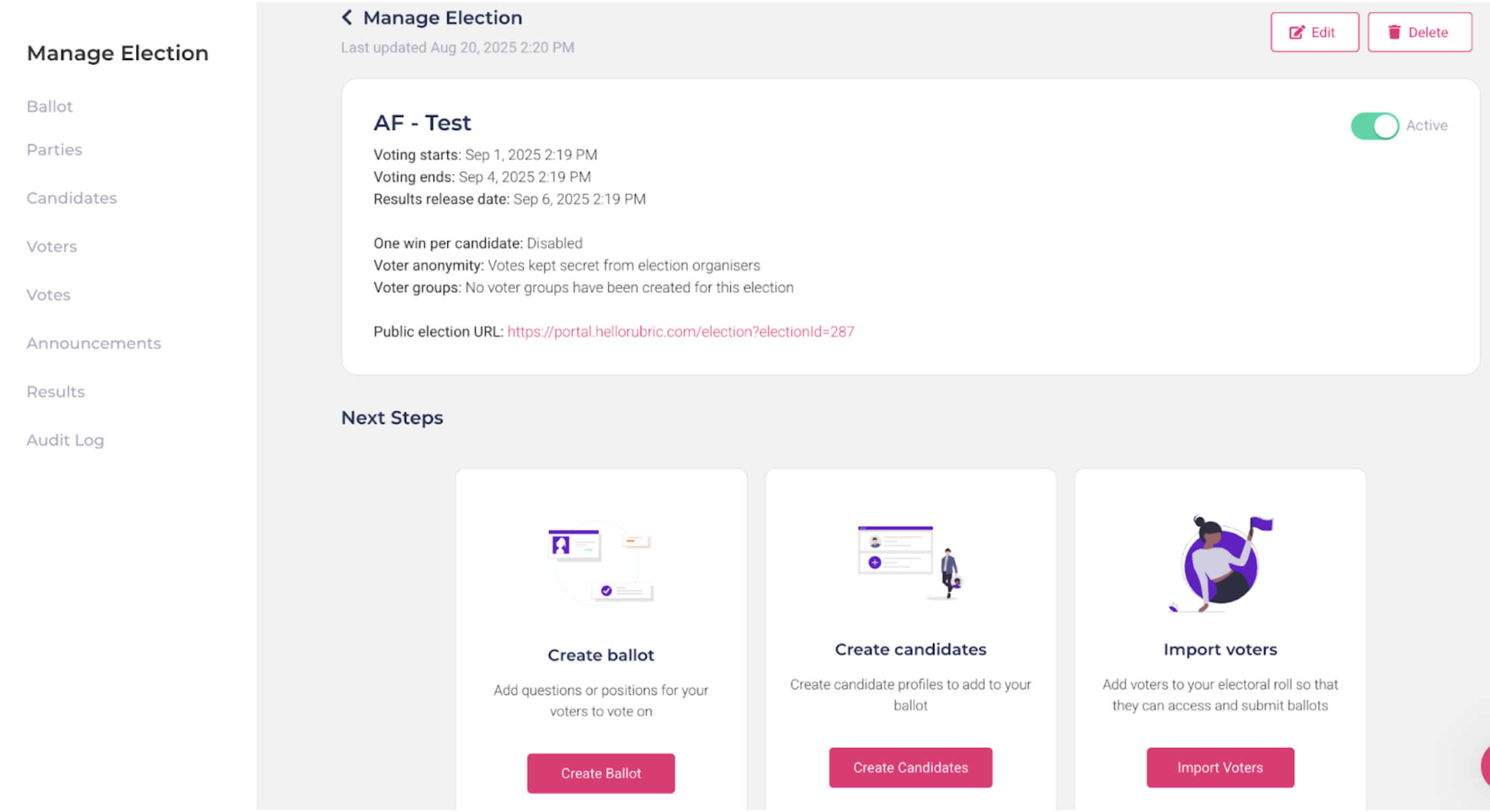
If everything goes well, you should be brought to the Election Management page:
Managing an Election
There are two main areas involved in setting up an election on Rubric: ballot and voter management, and election logistics. Each area should be reviewed and completed before the election is launched.
Creating the Ballot
To create a ballot, click Create Ballot in the left-most section at the bottom of the Election Management page. Rubric uses a drag-and-drop ballot builder, allowing you to add, arrange, and customize different voting elements based on your group’s needs.
The ballot header is a brief introduction to your members, including the title of your election (set in step one) and a description. Things that may be important to include in your election:
-
A brief (1-2 sentences) note, including a greeting, and emphasis of the importance of the electoral process.
-
A notice of the timeline of the elections. Including when the ballot opens, closes, and results are set to release.
-
A list of how a vote is considered invalid. This could include casting multiple votes, sharing the voting link with non-members, incorrectly stating your full name or registered member email, etc.
-
Note that these must be listed in your constitution or election package (formal documentation which is voted on) to be enforceable.
-
The ballot body is where you get to customize your ballot according to how your members are voting, and what your members are voting for. To insert these elements, simply click and drag them into the ballot in the centre of the screen, releasing them and ordering them as you prefer.
A full detailed overview of the different drag-and-drop elements your group could utilize can be found from the official Rubric help page. |
The usage of Student Bank Details and Student ID is strictly prohibited under the University of Alberta FOIP policy. Do not use these elements under any circumstances.
Once your ballot is complete, click Preview Ballot to ensure it is ready to be published. After that, don't forget to save the ballot. You'll return back to the Election Management page.
Creating Candidates
To create a candidate, start by clicking the “Manage Candidates" button at the bottom of the Election Management page. The four elements of a given candidate profile are summarized as such:
- Name - Should include first name (preferred) and last name of a candidate.
- Photo - Should be a professional photo for easy identification, screened by your Elections Officer.
- [Optional] Candidate Party - If the candidate is affiliated with a party or slate, select the appropriate party. Parties are used to group affiliated candidates and are separate from voter groups, which determine which voters are eligible to vote for specific positions.
- [Optional] Candidate Description - A brief description of the candidate, such as their experiences within the group, year of study, passion for the organization, etc.
Candidates can also be created when creating the ballot. You can also edit and delete candidates in the manage candidates page - but note that deleting a candidate will remove them from the ballot entirely, which may break your ballot if you try to publish it.
Importing Voters
In order for your election to run, eligible voters must be able to access the ballot and submit their votes. From the Election Management page, select Import Voters. There are two ways to add voters:
- Import Voters — This is the recommended method for adding multiple voters. Click Import Voters in the top-right corner and use the CSV template provided by Rubric to upload the required voter information.
- Add Voters — This is the manual method. Add voters individually by entering their name and email, then assign them to the appropriate voter group if applicable.
- If you add anyone as a test voter, make sure to remove all test voters before calculating and publishing results so that only legitimate votes are included in the final tally.
Election Logistics
Now that we've set up the ballot, candidates, and voters, we can move on to the election logistics. To start, return to the Election Management page of your election:
On the left-hand side you have the Manage Elections overview. Selecting ballot, candidates, or voters will take you to the same management pages as described above. Below is a brief summary of the other (new) logistical elements:
| Parties |
Allows you to Create Parties (cohorts of individuals, such as a slate or Co-Executives) for the ballot.
|
| Votes |
Once a vote is cast, you can see the full list of voters who completed the ballot.
|
| Announcements |
There are three types of announcements that may be edited and sent out...
You can either edit a pre-existing template linked to the Elections Feature, or edit directly via the Campaign feature. These can also be schedule-sent in advance! |
Once all of this is done, you can then set your election to Active by clicking on the toggle on the top-right side of the Election Management page! |
Announcing Results
Once the voting window has ended, the student group will need to validate and announce the results to their membership.
It is the group's responsibility to ensure all votes are valid, and the group meets Quorum and Majority. Please refer to the terminology page for more information.
- From the Election Management page, select Results from the left-hand menu.
- Click Count Votes in the top-right corner.
- Rubric will calculate the results for each position based on the ballot question type and counting method selected during ballot creation.
- Review the calculated results before publishing them.
- When the results are ready, click Publish Results.
- Published results will only become publicly accessible after the election's specified results release date.
- Once published, Rubric will generate a unique results link that can be shared with members.
Appeals & Auditing
In the case when an individual calls for an appeal (a reconsideration of the election procedure and/or election results) it is important to access information that supports the initial investigation. Here are a few key details that Rubric provides groups to ensure elections are run fairly:
Audit Log
Any single individual who accesses the Elections Feature on a group page is recorded in the Audit Log. Including the portal used to gain access, the type of action, the person's email, and a time stamp. Some key disclaimers:
- Administrators (SGS/UASU Staff) can access a group's elections via the administrative portal. These individuals are specifically marked as Union users.
- Access is when an individual only opens a page without interacting with any elements. Create or Update is when an individual physically alters the information/permissions of the election itself.
- If you are looking into the audit of a specific individual, you can Filter the table by that individual's email and see their full history on the elections page.
Appeal processes are required to be outlined in a student group's constitution, this should be referenced first in the case of an appeal. If additional support is needed, contact Student Group Services at clubs@uasu.ca.
Common Troubleshooting
With the Elections Feature on Rubric offering so many options, lots of student groups tend to run into roadblocks. Below are a few common issues, and their solutions. In the event that additional support is needed, contact Student Group Services at clubs@uasu.ca.
- Ensure that your election dates (announcement, voting window, results) are at least 24-hours in the future.
- Ensure that the Voters, Ballot, and Candidates field have all been set up. These are the bare minimum requirements for your election to be published.